Battery management systems (BMS) monitor and control system voltages of up to 800 V in electric vehicles. Additional diagnostic, communication and safety features increase the integration density of the printed circuit boards used.
These technically complex automotive PCBs must be able to withstand mechanical stresses, changing environmental conditions and high operating temperatures. Selective PCB potting using Wevo’s polyurethane systems, which are optimised for these applications and the corresponding production processes, ensures that electronics are protected in line with requirements and reduces the risk of potential failure.
Electronic potting compounds make automotive PCBs more reliable
With a Shore hardness of D 40 to 50, WEVOPUR 60210 FL T absorbs shocks and vibrations as well as stresses caused by fluctuating temperatures. Its thermal conductivity of 0.8 W/m·K enables heat to be distributed within the potted assembly and helps reduce temperature differences between the PCB components. The result: the risk of stress cracks and solder joint detachment is reduced. Optimised adhesion properties also ensure a durable bond between the potting compound and the substrate and help to prevent delamination. The PU potting also ensures that the electronic components are securely fixed in place and stabilised.
The dielectric strength of more than 20 kV/mm supports electrically insulated battery management systems. Moreover, the formulation of the electronic potting compound is designed to prevent electrochemical corrosion and protect the components from moisture.
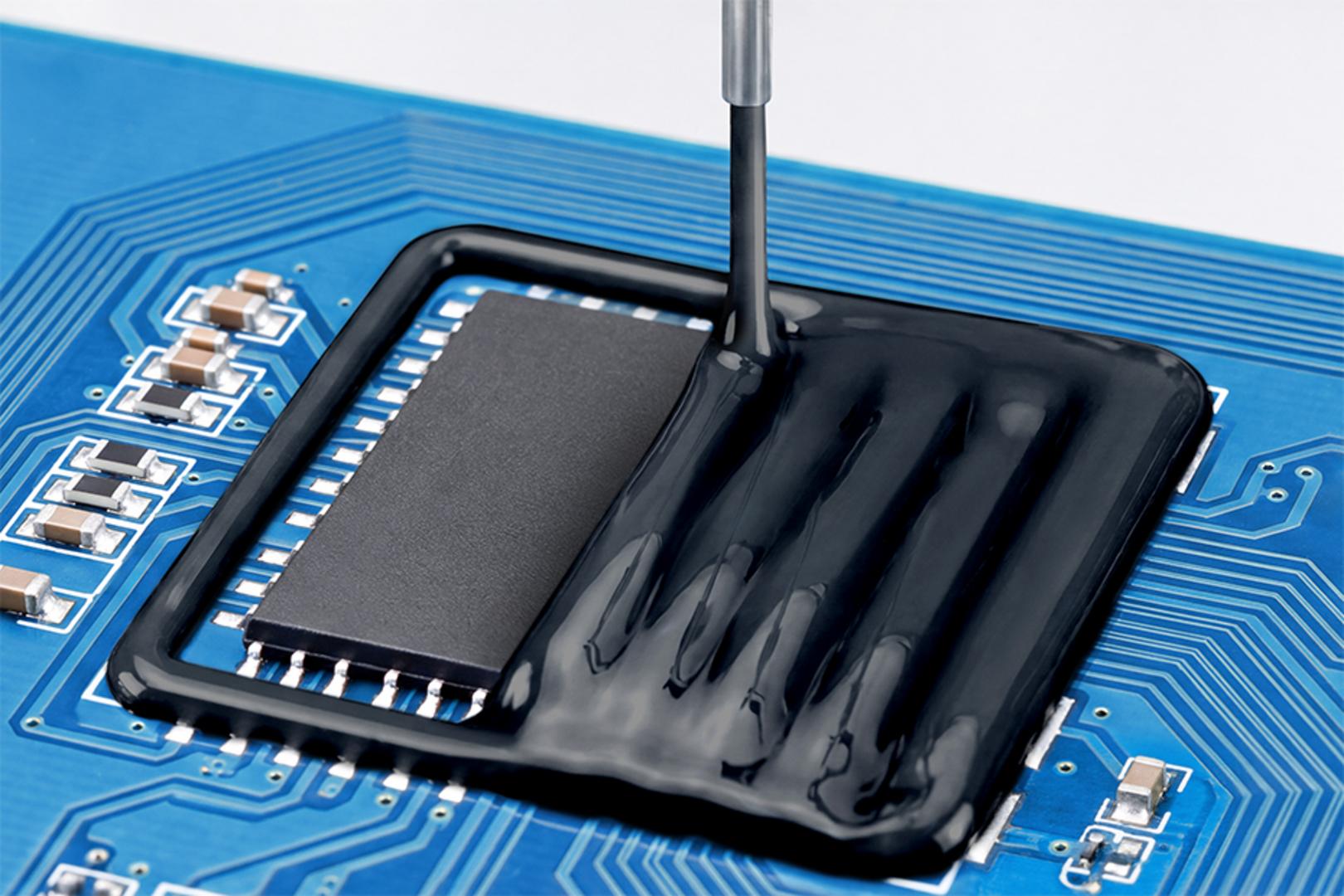
Selective polyurethane potting using the dam-and-fill method for process-optimised handling
With its tailored rheological properties, WEVOPUR 60210 FL T acts as both a barrier and a filler when applied using the “dam-and-fill” method. The flow behaviour and thixotropy are specifically adjusted so that the barrier retains its shape while the filler completely wets the area to be protected without forming any air pockets. These properties enable a reliable, automated production process using standard 2K mixing and dosing systems and reduce the workload involved in material qualification, storage and process management.
Advantages of this potting process for automotive PCBs: selective PU potting allows electronics to be protected in specific areas, while connectors and testing points remain freely accessible.
The layer thickness and amount of material can be adapted to varying PCB geometries by adjusting the process design and application speed. It is also possible to optimise the system for specific process windows and requirements.
Customised polyurethane systems for producing state-of-the-art electronics
Developing and manufacturing reliable battery management systems requires precisely coordinated mechanical, electrical, thermal and processing properties. As a polyurethane manufacturer with decades of expertise, Wevo develops material systems for potting processes such as dam-and-fill, combining them with material properties tailored to meet specific requirements – ranging from high-temperature and chemical-resistant to electrically conductive potting compounds.